The Biosynthesis of Cannabinoids

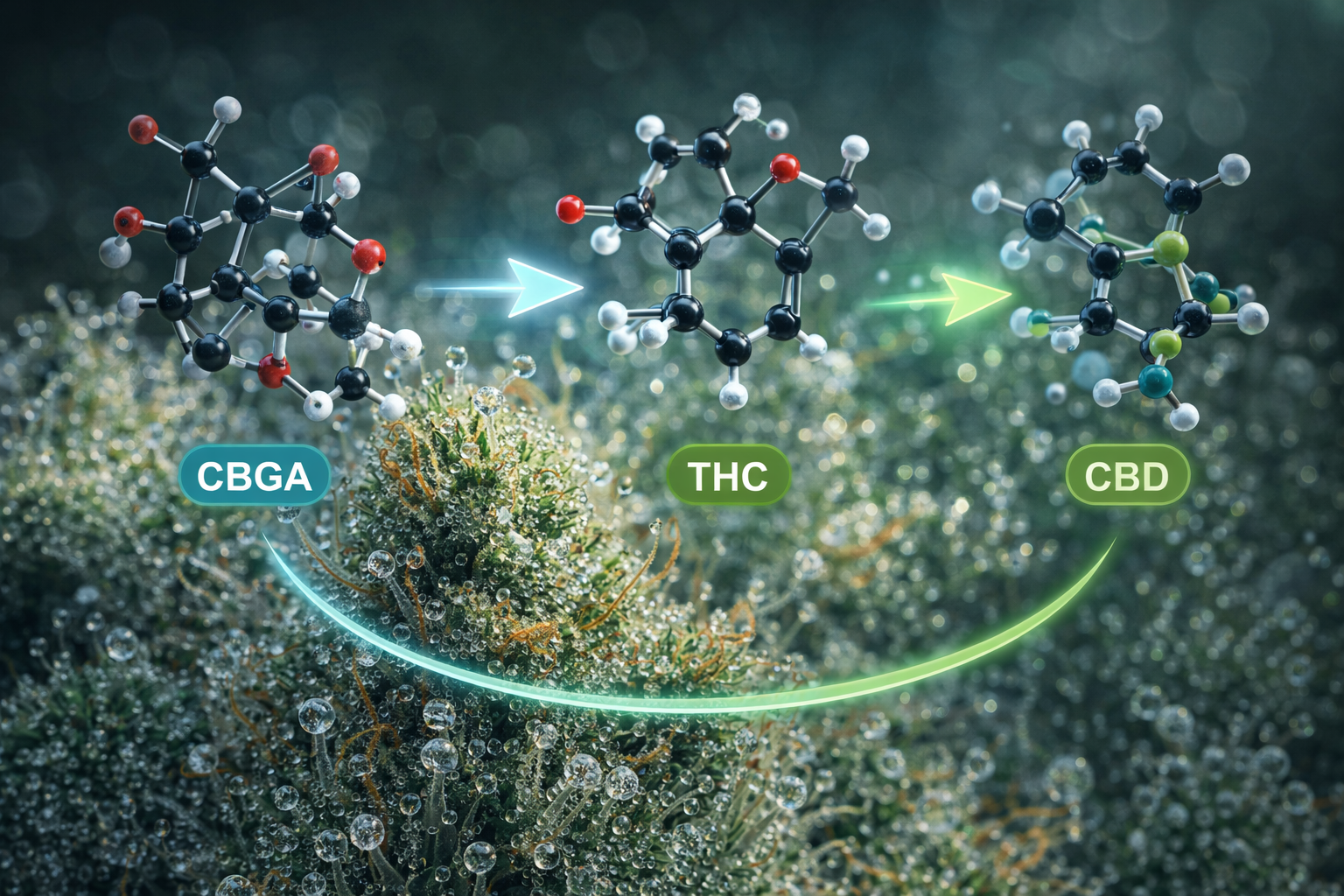
What Does Biosynthesis Mean?
The term biosynthesis describes the formation of chemical compounds within a living organism through enzymatic reactions.
In the cannabis plant, cannabinoid biosynthesis refers to the processes by which the plant’s characteristic active compounds are produced.
These reactions primarily take place in the glandular trichomes of female cannabis flowers.
“Cannabinoids are synthesized in the glandular trichomes of female cannabis plants.”
(Happyana et al., 2013)
Further details below
The Starting Point: CBGA
Most known cannabinoids originate from a common precursor:
CBGA (cannabigerolic acid)
CBGA is formed from two precursor molecules:
Olivetolic acid
Geranyl pyrophosphate (GPP)
This compound is produced by an enzyme known as geranylpyrophosphate:olivetolate geranyltransferase.
“CBGA is formed by the condensation of olivetolic acid and geranyl diphosphate.”
Taura et al., 2009
Further details below
CBGA then serves as the precursor molecule for several key cannabinoids.
Formation of the Main Cannabinoid Acids
Specific enzymes convert CBGA into different cannabinoid acids.
The most important are:
THCA synthase
CBGA is converted into THCA (tetrahydrocannabinolic acid).
THCA is the direct precursor of THC.
“THCA and CBDA are formed from CBGA by specific oxidocyclase enzymes.”
Taura et al., 2007
Further details below
CBDA synthase
CBGA is converted into CBDA (cannabidiolic acid).
CBDA is the precursor of CBD.
CBCA synthase
CBGA is converted into CBCA (cannabichromenic acid).
This compound is the precursor of CBC.
Why the Plant Produces Acids
The cannabis plant primarily produces cannabinoid acids, not neutral cannabinoids.
This means:
THCA instead of THC
CBDA instead of CBD
CBCA instead of CBC
These acidic forms are the natural products of biosynthesis in the plant.
Conversion Through Decarboxylation
The well-known cannabinoids are only formed through an additional chemical process:
Decarboxylation
In this process, a carboxyl group (CO₂) is removed through heat or aging.
Examples:
THCA → THC
CBDA → CBD
CBCA → CBC
This process can be triggered by:
Heating
Smoking
Vaporizing
Baking
Long-term storage
Relevance for Research and Breeding
Understanding cannabinoid biosynthesis is important for:
Medical research
Development of new cannabis strains
Targeted breeding of specific cannabinoid profiles
Biotechnological production of cannabinoids
Due to genetic differences between plants, the activity of the involved enzymes can vary. As a result, different strains exhibit varying levels of THC or CBD.
This article is for informational purposes only and is not a substitute for medical or therapeutic advice. If you have any health-related questions, please consult a doctor or another qualified professional.