The Structure of the Cannabis Plant – Anatomy and Key Plant Parts

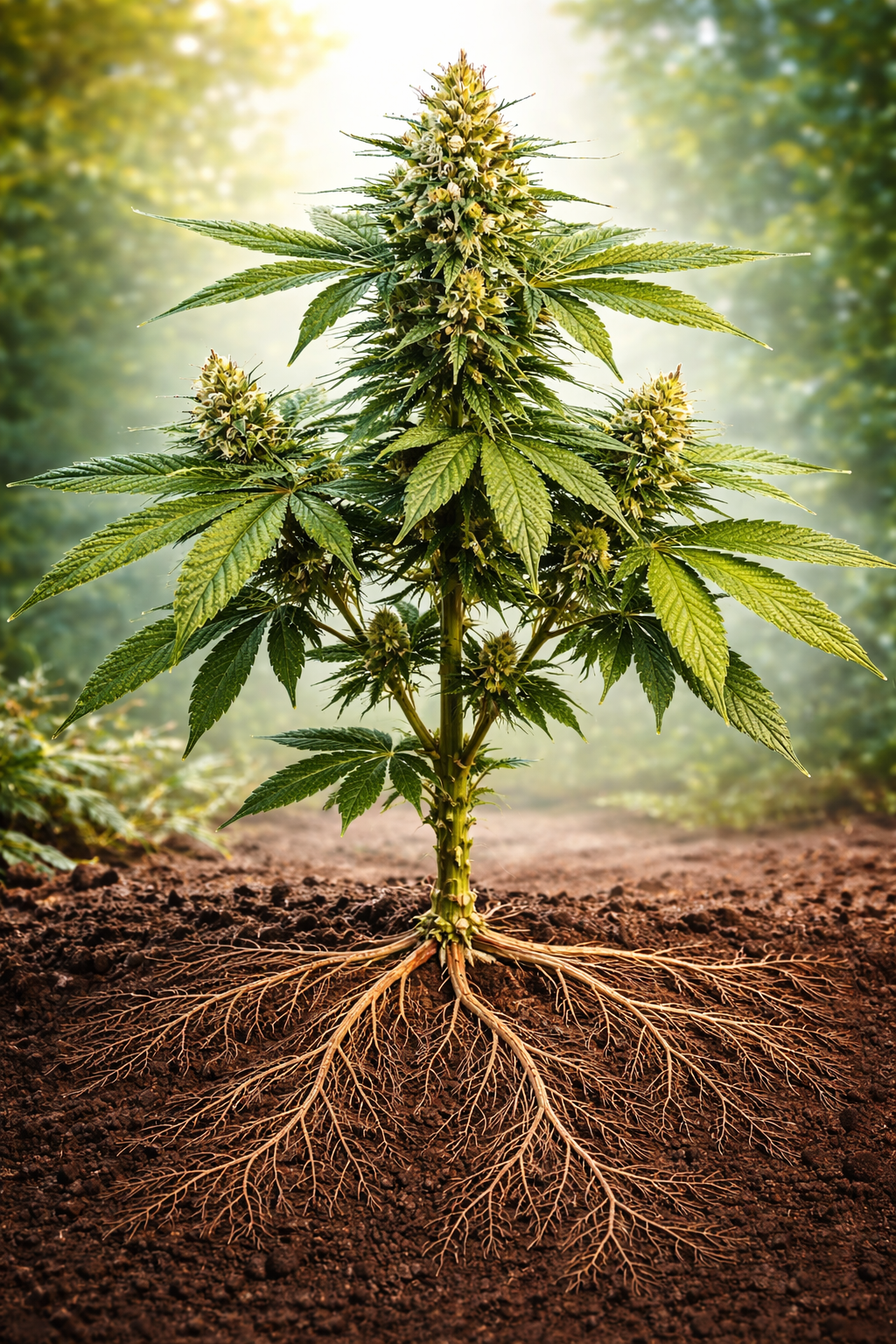
Introduction
Like all flowering plants, the cannabis plant has a clearly defined structure composed of different organs. These plant parts perform various functions, such as nutrient uptake, structural stability, and reproduction.
Understanding the anatomy of Cannabis sativa is essential for comprehending processes such as the formation of active compounds, plant growth, and its reproductive mechanisms.
The Root System
The roots are responsible for absorbing water and minerals from the soil. At the same time, they anchor the plant in the substrate.
Key functions of the roots:
Absorption of water
Uptake of nutrients
Storage of energy
Stabilization of the plant
Cannabis initially develops a taproot, from which a network of lateral roots later forms.
The Stem
The stem connects the root system with the upper parts of the plant and provides structural support. It also serves as a transport pathway for water, nutrients, and assimilates.
Inside the stem are vascular tissues:
Xylem transports water and minerals from the roots upward.
Phloem transports sugars and other metabolic products throughout the plant.
Nodes and Internodes
The stem contains so-called nodes. At these points, the following structures develop:
Leaves
Side shoots
Flowers
The spaces between two nodes are called internodes.
The length of internodes can vary significantly depending on genetics and light conditions.
The Leaves
Cannabis leaves are characteristically palmate and usually consist of several individual leaflets.
Main functions of the leaves:
Photosynthesis
Gas exchange
Regulation of transpiration
Through photosynthesis, the plant produces sugars that serve as an energy source for growth and metabolism.
The Flowers
Cannabis is a dioecious plant, meaning that male and female flowers typically grow on separate plants.
Male plants
Male plants develop pollen sacs that release pollen to fertilize female plants.
Female plants
Female plants develop inflorescences that contain resin glands. These glands produce cannabinoids and terpenes.
The female flowers are therefore the part of the plant that is most relevant for medical and pharmacological applications.
Trichomes – The Resin Glands
On the surface of the flowers, and partly on the leaves, there are trichomes, microscopic glandular structures.
Within these structures, many secondary plant compounds are produced, including:
Cannabinoids
Terpenes
Flavonoids
The highest concentration of these compounds is found in the trichomes of female flowers.
“Cannabinoids are synthesized and accumulated in the glandular trichomes of female flowers.”
Further details below
Importance of Plant Structure
The anatomy of the cannabis plant influences many important characteristics, including:
Growth
Production of active compounds
Reproduction
Adaptation to environmental conditions
A fundamental understanding of plant structure helps to better understand the biological processes of the plant.
This article is for informational purposes only and is not a substitute for medical or therapeutic advice. If you have any health-related questions, please consult a doctor or another qualified professional.