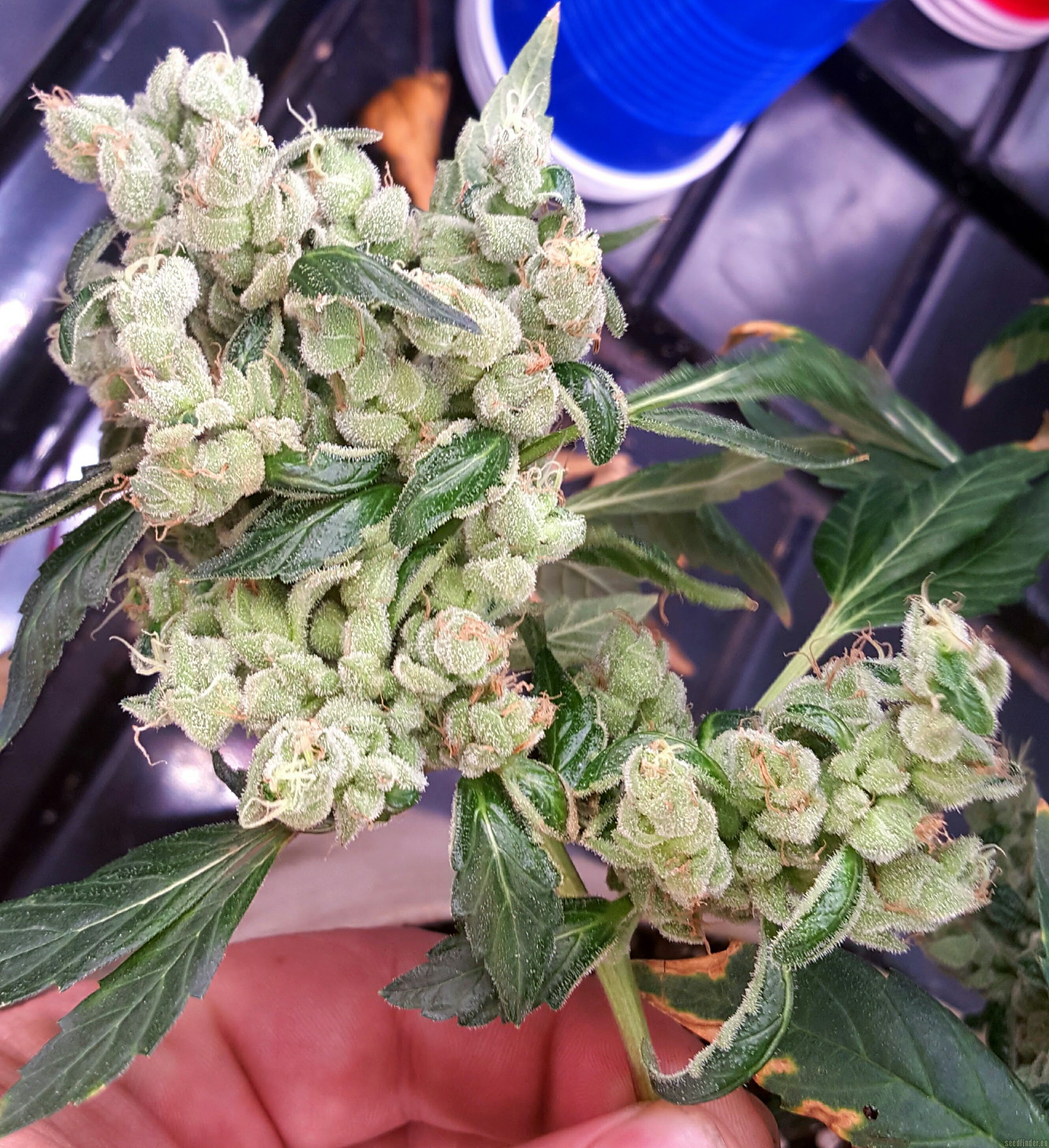
A growing guide presents Alaskan Thunder Fuck as a variety for cool, northern climates and gives a temperature range of 65 to 80 °F, about 18 to 27 °C. That fits its origin: the name has been tied to the Matanuska Valley north of Anchorage since the early 1970s. Strain descriptions classify it as sativa-dominant, while a seed listing carries it as an indica. Who bred it is not documented, and several seed companies list their own lines under the name.
Cultivation:
In 2017, the Anchorage Daily News described plants of 8 feet, around 2.4 m, that keep growing into the snow. Another description mentions pronounced stretch after the start of flowering and wide internodes. Several descriptions rate the difficulty as moderate, but they differ on flowering time: 7 to 9 weeks are given, elsewhere 9 to 10 weeks.
At low temperatures the guide advises planting in trenches rather than pots so that the roots stay warmer. According to one strain description, early topping makes growth bushier. Whether the variety is resistant to powdery mildew remains disputed: one description says yes, another considers it not disease-resistant.
In a grow with seeds from Holi Moli Seeds, harvest came after 62 days of flowering, and 2 plants yielded 356.7 g. An indoor grow reports heavy, dense flowers that needed support toward the end, resin that turned sticky early, strong odor during flowering and high water consumption; 2 of 5 plants there developed hermaphrodite flowers. A review, by contrast, describes dried flowers as light and airy.
Genetics and Origin:
According to the Anchorage Daily News, High Times listed weed from the Matanuska Valley as strong in September 1974 and called it Thunderfuck in January 1975. Strain descriptions give the lineage as a sativa from Northern California that came to Alaska in the 1970s and was crossed there with an Afghani, in some cases supplemented by a Russian ruderalis. None of these details is documented.
The abbreviations ATF and MTF are also in use, as are Matanuska Thunder Fuck and Matanuska Tundra. In 2017, a breeder from Juneau regarded the variety as a myth when speaking to the newspaper, and an officer of the Alaska State Troopers saw the name as a marketing tool. The same listing that carries the variety as an indica takes the view that MTF never referred to a specific variety but to good cannabis from the valley in general. The line is considered a parent of, among others, Alaska's Flavor by Apex Seeds, Clusterfuck by AK Bean Brains and Blissful Thunder by 517 Legend Seed Co.
Versions from Different Breeders:
Quebec Cannabis Seeds describes its own feminized version as a cross of Afghani, Alaskan sativa and Russian ruderalis and gives 8 to 9 weeks of flowering, 400 to 500 g/m² indoors, 850 g per plant outdoors and a harvest in October. Alaska Thunderfuck from GeneSeeds Bank, also feminized, resulted from 3 backcrosses to Matanuska Thunderfuck according to the breeder; stated are 60 to 65 days of flowering, harvest in early to mid October and fir-shaped growth.
Alaska Cannabis Cache gives up to 13 weeks of flowering for its regular Matanuska ThunderFuck. The breeder describes it as an inbred line that has been regrown again and again since 1974 and passed on to only a few growers in Southeast Alaska. Further lines under the name come from Seed Supreme, Twisty Seeds and Holi Moli Seeds.
THC and CBD Content:
Strain descriptions give 16 to 23 % THC. Of the breeders, Quebec Cannabis Seeds is the one to quantify both values, with 22 % THC and 0.6 % CBD.
Aroma and Flavor:
Pine, lemon and menthol are at the center of the descriptions, along with sage and skunk. Reviews and user reports add earthy and sour notes with a biting taste, 2 reports also chocolate, one of them together with mint and citrus.
The terpene profile is known only from strain descriptions, which contradict one another: one lists myrcene ahead of caryophyllene and limonene, another linalool and humulene ahead of myrcene, a third pinene, terpinolene and limonene.
Effects:
Reports consistently describe a delayed onset of effects, which are then felt mainly in the head. Euphoria and energy, creativity and talkativeness are mentioned, at times silliness; 2 reports stress a clear head without heaviness in the body. One grow report, by contrast, speaks of pronounced physical relaxation that does not cause tiredness.
Reported side effects are dry mouth, dry eyes, headaches and dizziness. Individual reports mention restlessness, anxiety and paranoia at larger amounts.




 Mint
 Sage
 Pine