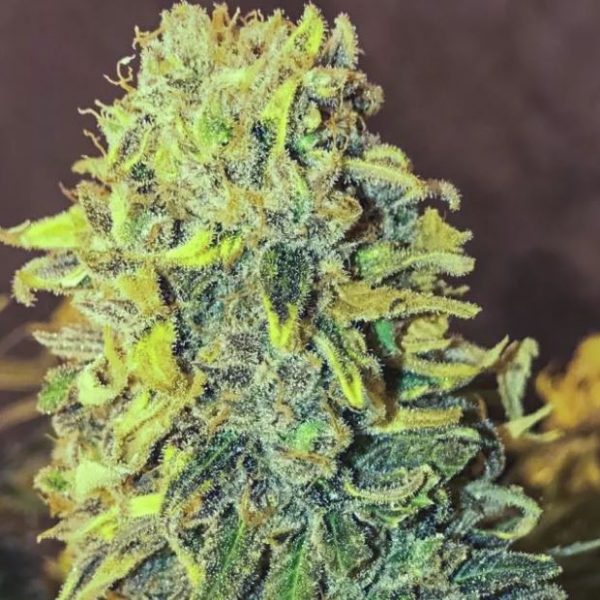
Two breeding lines from Barney's Farm go into Pineapple Chunk: the breeder's own Pineapple and a cross of Cheese and Skunk #1. The breeder lists the strain as a feminized hybrid with 80 % indica and, by its own account, wanted to combine the flavor and character of both parents in one plant.
Genetics and Origin:
In its pedigree, Barney's Farm gives Pineapple × Skunk #1 × Cheese, a three-way cross whose second half was already a hybrid of Cheese and Skunk #1. Abridged descriptions name only Pineapple and Cheese, or only Cheese and Skunk #1, as parents. On the ratio, one strain description contradicts the breeder and classes the strain as a balanced hybrid with 50 % indica and 50 % sativa.
Two sources cite a win at the High Times Cannabis Cup 2009, one of them explicitly in the Indica category; Barney's Farm itself calls the strain a cup winner without further detail. In the Indica ranking of the 2009 Amsterdam Cup, won by Starbud from Hortilab, Pineapple Chunk is not among places 1 to 3. Which competition is meant remains open.
The strain is documented as a parent in several crosses, among them Chunk Norris by Green Blood Genetics, Hawaiian Zombie Duck by TNT Genetics, Lois Lane by Red Bee Seeds, Monkey Juice by Bred by 42 and Maui Pineapple Chunk by Pua Mana Pakalolo.
Aroma and Flavor:
Barney's Farm describes the smell as earthy with cheese and pineapple, and the taste as sweet pineapple with cheese and pine. Other strain descriptions put a sour note with skunk and cheese in the foreground, beneath which the pineapple only faintly resonates. Grow reports show how strongly the aroma depends on the phenotype: some plants smelled of pure skunk in flower, others tropical with a share of skunk, still others earthy with pine and citrus. Consumers also mention mango, pepper, orange and a blue cheese tone on the exhale; in isolated cases the taste was described as soapy.
Effects:
The breeder speaks of a head-focused effect that is euphoric and invigorating and at the same time binds strongly to the couch. This range also appears in the user reports reviewed. The common denominator is relaxation, good mood and euphoria. Some reports describe focus, creativity or talkativeness, others heavy sedation with hunger and sleepiness. One report describes the effect as dose-dependent: calm focus at a low amount, sluggishness at a higher amount. Side effects include dry mouth, dry eyes, nervousness, dizziness and a strong urge to cough, in one report also a faster pulse.
THC and CBD Content:
For its own version, Barney's Farm states 28 % THC and calls the CBD content high without giving a figure. Another strain description lists 16 to 26 % THC at 1 % CBD, and a further one shows 1 % CBG.
For a pre-roll reviewed in Illinois in 2021, a test figure of 14.54 % THCA was available, a single measurement with no lab named. Myrcene, terpinolene and ocimene were listed as the leading terpenes. Strain descriptions put terpinolene first in some cases and myrcene in others.
Versions from Different Breeders:
Besides the original, other suppliers offer feminized seeds under the name and state the same pedigree. Whether the genetics are identical cannot be determined from the information given.
- Barney's Farm: 55 to 60 days of flowering, indoor 550 to 650 g/m² at 90 to 110 cm height, outdoor 1000 g per plant at 120 to 150 cm, harvest in the 3rd to 4th week of September, 28 % THC.
- Semyanich: 55 to 60 days of flowering, indoor 600 g/m², outdoor 350 to 500 g per plant, 90 to 100 cm height, 25 % THC and 1.1 % CBD.
- United Cannabis Seeds: 21 to 26 % THC and 0.5 % CBD at 80 % indica.
- Bulk Seeds: 55 to 60 days of flowering, yield and THC content rated high without a figure, one dominant main cola with dense, resin-rich flowers.
Cultivation:
Barney's Farm describes the plant as vigorous and stable, and as resistant to mold and disease. According to another strain description, it responds well to topping, has a medium to high nutrient demand and is suited mainly to indoor cultivation, for which it lists 55 days of flowering and 450 to 550 g/m².
The grow reports paint an inconsistent picture; indoor flowering time ranged from 55 to 75 days. In one case the plant grew in a fir-tree shape from 30 to 140 cm, set flowers only after 3 to 4 weeks under 12/12, developed foxtails and needed 75 days; the grower found it sensitive. Another grow reached 130 cm after 60 days with many strong side shoots and hard buds with a low leaf share. A third phenotype stayed compact at 65 cm, hardly produced side branches and, in the grower's assessment, suited a Sea of Green; its buds turned out rather loose after drying. Flowers harvested outdoors are also described as looser than those grown indoors.
Several growers report a pronounced tendency to hermaphrodites and a need for support during flowering. The reports contradict each other on susceptibility to mold. Purple tones were observed in isolated cases on dried flowers.




 Pine
 Mango
 Sour